

Treating Fevers

August 14, 2020

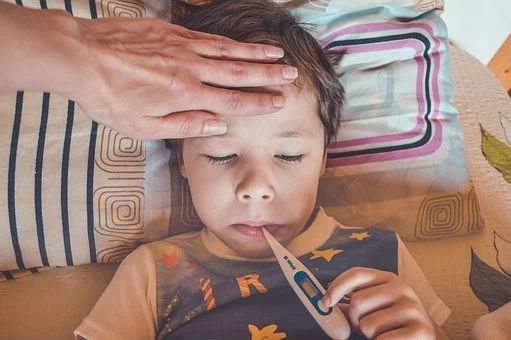
For adults, the NHS (2020) advises that fevers ‘in themselves’ are not ‘life-threatening’ though it recommends medical advice be sought for those with serious underlying conditions.  For children, the NHS (2017) has lots of advice regarding fever management and when to seek medical advice.

‘Accumulated data now suggest that fever has a protective role’ in fighting infection, but you should obtain medical advice if you have an underlying medical condition or are worried about a fever El Radhi (2012). 

The usual advice of ‘rest and plenty of fluids’ applies with homeopathy too, but observation of fever symptoms can provide essential clues to a first remedy which will give you a head start in tackling infection and Belladonna and aconite are useful first stage remedies (Cummings and Ullman, 2020). 

Cummings and Ullman’s classic ‘Everybody’s Guide to Homeopathic Medicines’ was a constant companion before taking my course.  It makes Belladonna’s flushed face, radiant heat and ‘glassy eyes with dilated pupils’ easy to identify.  Aconite symptoms are distinguished by their appearances after exposure to cold wind, giving ‘anxious, restless and fearful’ symptoms, but in contrast to Belladonna, their pupils may be ‘contracted’.

Miranda Castro’s (1992) ‘Homeopathy for Mother and Baby’ also ascribes ‘sudden onset’ to Belladonna, and adds alternating chills and heat, accompanied by ‘alternately dry and moist’ skin, ‘grinding of teeth, delirium… worse for light, being uncovered’ and from the afternoon onwards.

Castro describes Aconite as ‘heat alternating with chills’, ‘cheeks alternately hot and red and pale … or one red and the other pale.  Internally, they might feel hot and be kicking off covers, whilst externally they are cold.  They may have paleness on getting up and be ‘worse at night and for touch’. 

Lecturer, Hilery Dorian observes that a child’s Stramonium fever might resemble Belladonna with a red face and pupil dilation, but its fearful, clinging state marks a distinction.  A Stramonium child may fear the dark, and imaginary characters such as witches, ghosts or wild animals (Dorian 2020).

Farokh Masters clinical observation of children notes Stramonium’s ‘descending chills’ with ‘delirium’, ‘convulsions’, ‘loquacity’, ‘restlessness’ and even ‘shrieking’, an aversion to being uncovered, ‘icy coldness of hands and feet’, yet a ‘hot head and face’, ‘heat and pain in the eyes’, with an ‘insatiable thirst for large quantities of water’ and consequent frequent urination.

Dorrian states Ferrum Phos can be used for the first stage of any fever, especially if it may have erupted from the suppression of sweat.  She describes it as falling somewhere between Aconite and Belladonna and the sluggishness of Gelsemium (below).  There is alternating redness and paleness.  There may be a red and throbbing ear, or an accompanying nose-bleed, and a worsening between 4-6 a.m. 

Adults needing Nux Vomica may have over-indulged: in eating, drinking, drugs or staying up late.  There is ‘extreme chilliness… greatly worsened by uncovering’ often accompanied by ‘digestive symptoms…worse in the morning or the open air’ (Cummings and Ullman, 1990).

In children, Castro (1992) associates Nux Vomica with ‘getting chilled’.  Therefore, they are better for ‘heat… and hot drinks’ and worse for ‘cold wind, fresh air, loss of sleep, mornings, winter, uncovering, and walking’.  They have ‘shivering and sweating’, chilling can occur from an uncovered limb or they may feel cold on just one side, or – the opposite of aconite – ‘hot externally and chilly internally’. 

‘Rich or fatty foods’ might contribute to Pulsatilla fevers , accompanied by characteristic desire for affection, changeable moods, whining and absence of thirst (Cummings and Ullman, 1990).

Castro (1992) also implicates fatty foods and describes the contrariness of Pulsatilla fevers; not only worse from cold, wet or windy weather but for sun exposure, stuffy rooms, and twilight. They have ‘dry mouths’ without thirst, may have ‘cold hands and feet’, yet become ‘flushed in warm rooms’ and are ‘better for fresh air’ (Castro, 1992). 

Dorrian (2020) states that Chamomilla fevers may have one red cheek which may be associated with teething.  Their head may be sweaty, they may want to be held and are likely to be irritable.  Master (2003) cites ‘anger or vexation’ especially during teething and describes cold limbs contrasting with a burning, perspiring face, and they are worse for a draft. 

In describing a Gelsemium fever, the National Centre for Homeopathy uses the expression – the four d’s – ‘dull, droopy, dumb, dopey’  – to the point of not wanting to move, with a ‘dull headache, droopy eyes, heavy limbs’ and characteristic ‘chills up and down the back’.  Dorrian (2020) adds weakness and shivering, heavy eyelids, sluggishness and lack of thirst.

If you need more advice, call me.  By all means, check out your illness with a doctor, but if there are no reasons to give you immediate concern, you may want to try home treatment with fluids, rest and a remedy whilst you wait for a doctor’s appointment. 

Castro, M., 1992, Homeopathy for Mother and Baby, Macmillan, London.

Cummings, S., and Ullman, D., 1990, Everybody’s Guide to Homeopathic Medicines, Gollancz, London.

Dorrian, H., 2020, Centre for Homeopathic Education, CHE Online Course, Mother and Baby, Newborn and Your Children,

National Center for Homeopathy, 2017,

NHS/Inform, 2020, Fever in Adults,

NHS, 2017, High Temperature (fever) in children,

Master, F. J. 2003, Clinical Observations of Children’s Remedies, Lutra, Eindhoven, Netherlands. Radhi, A. S. M., 2012, Fever Management: Evidence versus Current Practice, World Journal of Clinical Paediatrics, 2012 Dec 8; 1(4): 29–33.

Treating Fevers
Related Article: 
By Garden July 17, 2024
By Jean Powis, Registered Homeopath, from the Homeopathic Garden New life bursts from every field and hedgerow as days lengthen and warmth returns. Animals flowers and trees bloom in the glory of Spring. However, fluctuating temperatures and the increase in pollen increase susceptibility for hay-fever sufferers: ‘Weather changes, rain, heat, sun… wind… open air, … […]
Smiling person with gray wavy hair wearing a purple top and beaded necklace against a soft floral background
JEAN POWIS, REGISTERED HOMEOPATH AND MINDFULNESS TEACHER

I write these articles with the hope that something here helps you feel a little more understood.


If a topic resonates, feel free to contact me to find out how I can help you explore them further.

Homeopathy & Mindfulness Articles

By Garden July 17, 2024
By Jean Powis, Registered Homeopath, from the Homeopathic Garden New life bursts from every field and hedgerow as days lengthen and warmth returns. Animals flowers and trees bloom in the glory of Spring. However, fluctuating temperatures and the increase in pollen increase susceptibility for hay-fever sufferers: ‘Weather changes, rain, heat, sun… wind… open air, … […]

By Garden July 17, 2024
By Jean Powis, Registered Homeopath, from the Homeopathic Garden After a soggy Spring, Summer seems a reluctant arrival, but nonetheless it is still warm enough for outdoor pursuits. Whether you’re kite surfing, riding horses, walking through the woods or just pottering around the house, if you manage to run into a scrape, you might be […]

By Garden July 17, 2024
By Jean Powis, Registered Homeopath, from the Homeopathic Garden After a soggy Spring, Summer seems a reluctant arrival, but nonetheless it is still warm enough for outdoor pursuits. Whether you’re kite surfing, riding horses, walking through the woods or just pottering around the house, if you manage to run into a scrape, you might be […]

By Garden July 17, 2024
Medicalising or managing the menopause? By Jean Powis, Registered Homeopath, from the Homeopathic Garden Is it a serious issue, or nothing to mind about? Updating the 2010 Equality Act sounds serious – with expectations of ‘reasonable adjustments’ in the workplace rendering ‘unfavourable’ treatment of menopausal women as ‘discrimination’. Research (2023) by the Chartered Institute of […]

Feeling something resonate?

You’re welcome to reach out whenever you’re ready.
Black curved line forming a loop on a white background